

What is anki-llm?
anki-llm is a CLI and terminal UI for repeatable, reviewable AI workflows over an Anki collection. It connects Anki Desktop to OpenAI-compatible language models to transform existing notes, generate candidate cards, add audio, and maintain card templates as files.
What people say
Section titled “What people say”What’s next get AI to answer your flashcards for you?
grei_earl (Reddit)
I love this. The README is extremely detailed and clear, and using AnkiConnect to edit decks in-place avoids the usual apkg headaches.
rahimnathwani (Hacker News)
This is cool!
Hsaeedx (Reddit)
Why anki-llm?
Section titled “Why anki-llm?”- Improve existing notes by verifying translations, adding grammar explanations, creating hints, or filling structured fields across a deck.
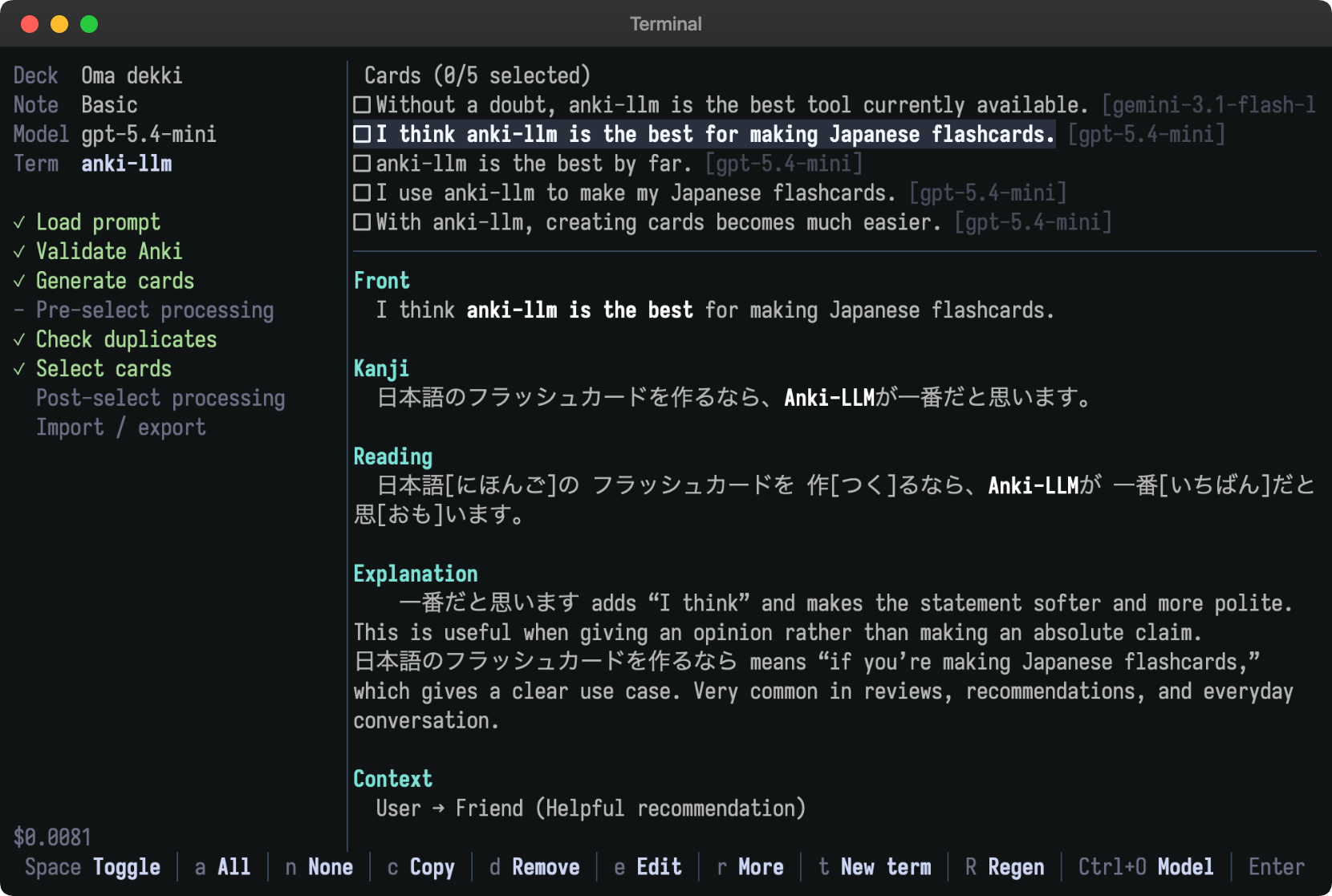
- Generate several contextual cards for a term, inspect and edit them in the terminal UI, and import only the cards you select.
- Add speech with OpenAI, Azure, Google Cloud, Amazon Polly, or Microsoft Edge text-to-speech.
- Pull note type HTML and CSS into ordinary files, edit them with normal tools, and safely push them back to Anki.
- Use OpenAI, Gemini, DeepSeek, xAI, OpenRouter, Ollama, or another OpenAI-compatible endpoint, with model selection, token accounting, and estimated costs for known models.
- Give coding agents structured access to collection data through the JSON-oriented
anki-llm querycommand.
Choose a workflow
Section titled “Choose a workflow”- Process a file to export, transform, diff, and import a reviewable CSV or YAML file. File processing supports incremental output and resume for interrupted jobs.
- Process a deck to update matching notes directly with a small preview, automatic snapshots, history, and conflict-aware rollback.
- Generate cards to review, edit, regenerate, and deduplicate candidate cards in an interactive terminal UI before import.
- Use text-to-speech to fill audio fields while preserving existing audio by default.
- Manage note types to keep card template HTML and CSS in files that work with diffs, version control, editors, and coding agents.
- Work with agents to describe an outcome while an agent inspects the collection, prepares files, and begins with a safe sample.
Design principles
Section titled “Design principles”An Anki collection is valuable, stateful data, while language model output is probabilistic. Prompt files make transformations repeatable and explicit output fields keep updates constrained. Preview, dry-run, and limit controls expose mistakes before a whole deck is changed. Exported files provide a diffable review boundary, while direct processing creates rollback snapshots.
Batch workflows support concurrency, retries, incremental progress, and file-mode resume. They can run against local or hosted OpenAI-compatible endpoints. Manual copy mode also supports browser-based language models when an API workflow is not appropriate.
Generation keeps acceptance decisions with the user. The terminal UI supports duplicate detection, editing, regeneration, model switching, and optional text-to-speech before selected cards enter Anki.